Why you should start your morning without your phone
If the first thing you touch every morning is your phone, you're in very good company. The alarm goes off, you turn it off, and before you know it you're three emails and two headlines into the day.
It's completely normal. In the American Psychological Association's Stress in America survey, 86% of U.S. adults said they check email, texts and social media "constantly or often." And those constant checkers reported more stress than everyone else: 5.3 against 4.4 on a ten-point scale (APA, 2017).
This is the first of three guides on phone-free time across the day: mornings, lunch and evenings. Let's start at the beginning.
Why the first hour matters so much
Think about what your morning looks like when the phone comes first. Before you've had a glass of water, you already know what your boss needs, what went wrong in the world overnight and what everyone in the group chat had for dinner.
None of that is yours yet. The morning is the one part of the day nobody else has claimed, and whatever fills it tends to set the tone for everything after.
There are a few reasons it's worth protecting:
- You get to decide what today is about. Ten quiet minutes before the requests start is enough to choose one thing that matters.
- Your head starts clear. Every notification leaves a little something behind that follows you into the next task.
- It's the easiest hour to win. You're at home, it's quiet, and honestly, very little can't wait until 8 o'clock.
What to do instead
The natural next question is, "OK, but what do I actually do with that time?" The good news is there's no right answer. The point is that you choose it. A few ideas:
Get outside, even for five minutes. Take your coffee to the porch. Walk the dog the long way. Morning daylight is one of the strongest signals your body uses to set its daily clock, so it helps your sleep that night too.
Move a little. A walk, a stretch, a few minutes in the yard. It wakes you up more kindly than a feed does.
Have breakfast with the people you live with. For a lot of families, it's the only unhurried conversation of the day.
Write a few lines. What's on your mind, what you want from today. Two minutes in a notebook goes further than twenty minutes of other people's thoughts.
Read something with pages. One chapter. That's it.
What changes in your body
I've been tracking my own phone-free time against my Oura ring since July. It's one person's data, so read this as a field note and not a study.
I'll be honest: my mornings don't show a clear signal yet. Part of the reason surprised me. Oura only measures stress and restorative time while you're sitting still, and my phone-free mornings are mostly walks and chores. So the ring often isn't measuring at all, and the numbers dip simply because there's less to count.
Moving around in the morning is good for you. It just doesn't show up in those two numbers. The clearer changes in my data come later in the day, at lunch and in the evening.
How to make it stick
- Charge your phone outside the bedroom. If it isn't on your nightstand, it can't be the first thing you grab. We wrote a whole guide on keeping your phone out of the bedroom.
- Buy a cheap alarm clock. It takes away the only real reason to pick the phone up.
- Pick an end point, not a timer. "No phone until after breakfast" is much easier to keep than "30 minutes without it."
- Start with Saturdays. One morning a week. Let it spread from there.
- Keep track of it. The Saalo app counts your time away from your phone, and its Phases of the day view shows your mornings, middays and evenings side by side. If you wear an Oura ring, you'll see how your own numbers respond.
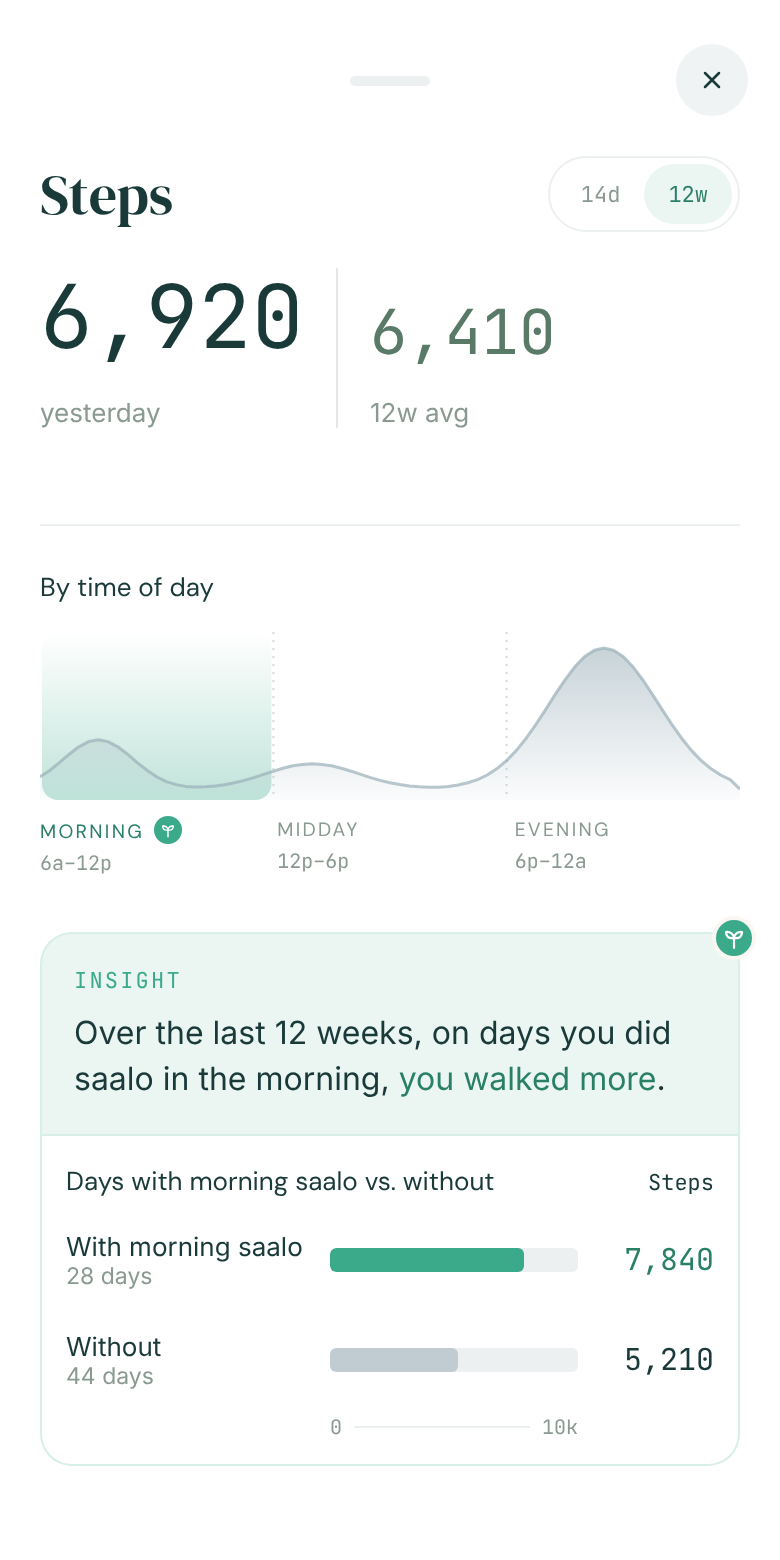
Tomorrow, leave your phone where it charged until the kettle boils. That's the whole first step.