Why you should take your lunch break without your phone
Most of us treat a few minutes on the phone as a break. You finish a meeting, grab a sandwich, and open Instagram as a little reward. It feels like rest.
The research says it mostly isn't.
Why a phone break doesn't rest you
In 2019, researchers at Rutgers asked 414 people to solve a set of word puzzles with a break halfway through. Some spent the break on their phone, some on a computer, some with a paper flyer, and some didn't get a break at all.
The people who spent their break on a phone felt the most mentally drained. Afterward, they took 19% longer to finish and solved 22% fewer problems than the other break groups combined (Kang and Kurtzberg, 2019).
Why? Because a phone break keeps your brain doing the same kind of work it was already doing all morning: reading, deciding, reacting. The topic changes. The effort doesn't.
Why the middle of the day matters
It decides your afternoon. A real pause around lunch is often the difference between an afternoon that holds together and one that slowly falls apart.
It's the busiest part of the day. Messages and meetings pile up in the middle hours, which is exactly why a short stretch without your phone feels so good.
It's the easiest one to skip. Mornings and evenings have natural edges. Lunch doesn't, so it only happens if you decide it will.
How to spend a phone-free lunch break
You don't need an hour. Ten to thirty minutes is plenty. The trick is to do something different with your body and your mind:
- Walk. Around the block, to get lunch, anywhere outside. New scenery does a lot of quiet work.
- Eat without a screen. Actually taste the food. Sit by a window. If there's someone to eat with, eat with them.
- Do something with your hands. Water the plants, make a proper cup of tea, tidy a shelf. Simple tasks let your mind wander, which is when it does its sorting.
- Close your eyes for ten minutes. Lie down if you can. Doing nothing is a skill, and a useful one.
If you find yourself reaching for the phone anyway, that's normal too. We explain why you keep checking your phone in another guide.
What changes in your body
I've tracked my own phone-free time against my Oura ring since July. This is one person over about twelve weeks, so it's a field note and not a finding.
Midday is where my numbers move the most. On days I put my phone away for at least ten minutes between noon and 6 p.m., my Oura restorative time averaged 36 minutes, against 17 on days I didn't (14 days with, 15 without). My overnight HRV was a little higher after those days too: 56 against 52.
Restorative time is Oura's measure of time spent in a calm, recovering state during the day. It only counts while you're still, which is what makes it interesting here: the pause itself is showing up on the ring.
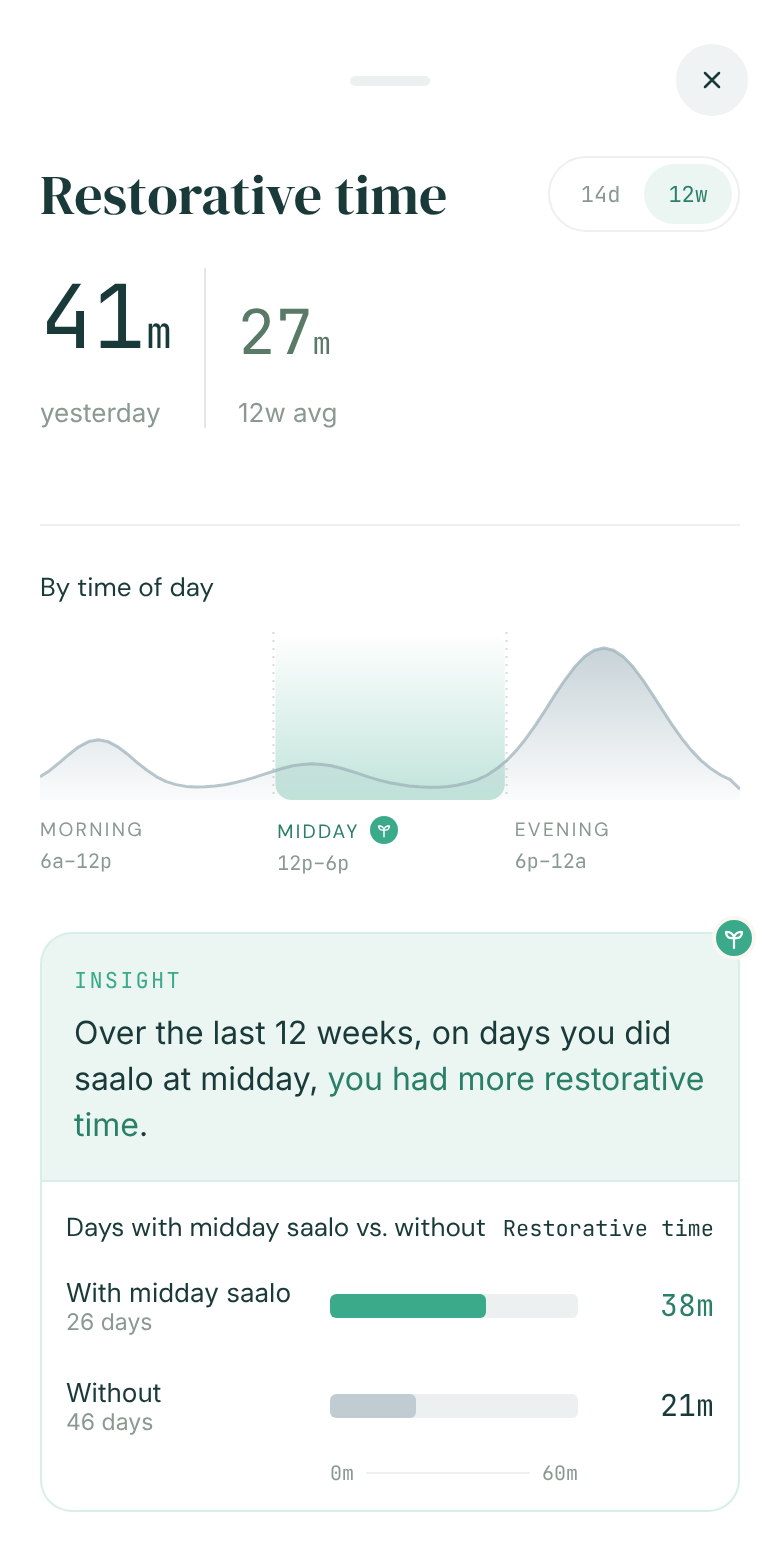
It isn't statistically settled yet. I need more days before I'd call it proven. But it's the pattern I'd most like other people to try for themselves, and the Saalo app's Phases of the day view shows exactly this comparison with your own Oura data once you have a few weeks of practice.
For the other two parts of the day, see phone-free mornings and phone-free evenings.
The Saalo app is free on the App Store if you'd like to see your own lunchtime numbers.